
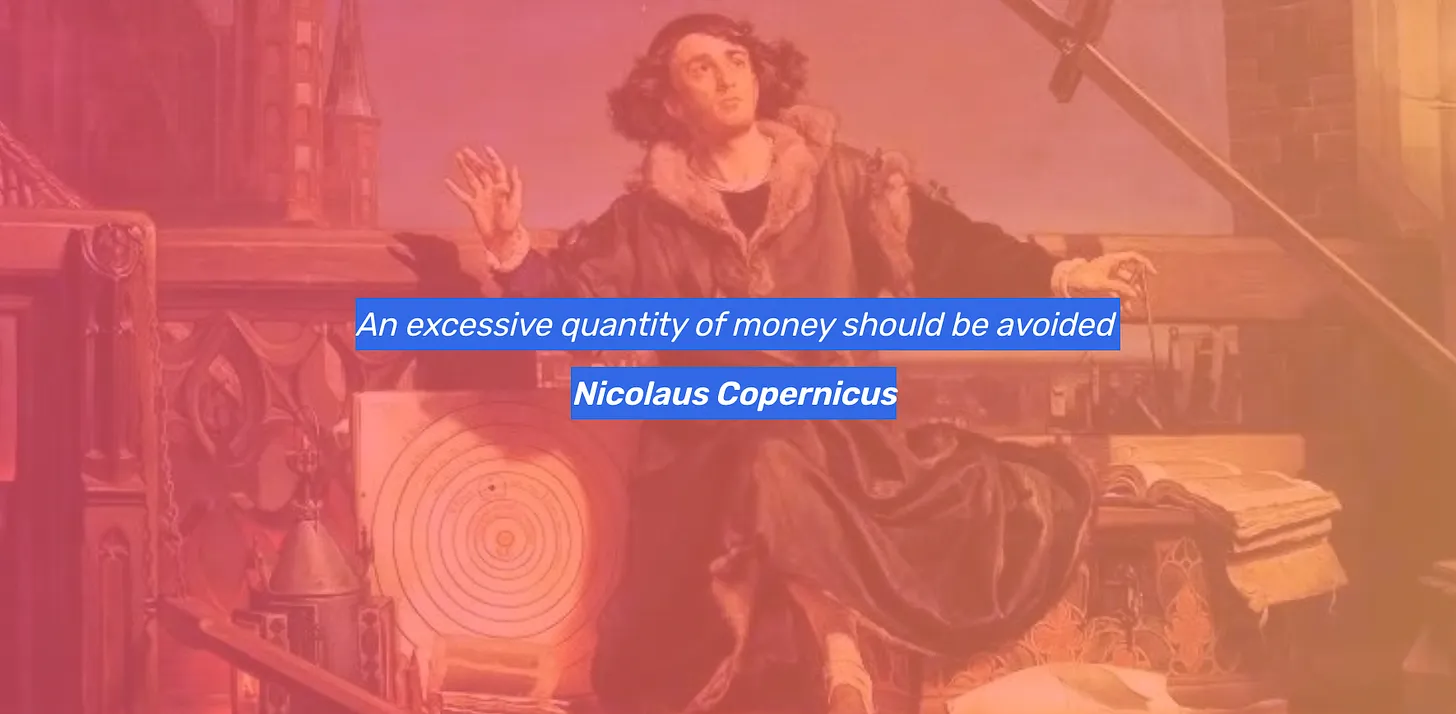
The OG Quantity Theory of Money (QTM)

Ativ
What is the original quantity theory of money? Who made it?
We in our sluggishness do not realize that the dearness of everything is the result of the cheapness of money. For prices increase and decrease according to the condition of the money. - Nicolaus Copernicus
In economics, one of the common theories thrown around is QTM, also known as the Quantity Theory of Money. Many people use QTM as a formula and a general theory explaining the relationship between money supply and the general price levels of goods and services. It has been coined and re-coined by many economists over the years, including John Locke and Milton Friedman.
Every time it is re-coined, its meaning shifts slightly, for better or worse. So who was the OG, and what did he actually theorize?
What is the original QTM?
The original QTM stated that prices of goods and services change in direct correlation with the supply of money in society.
In other words, as more money is introduced (an increase in the money supply), there is a direct correlation with changes in the price of goods and services within an economy.
Who coined QTM?
The original creator of QTM was Nicolai Copernici, better known as Copernicus.
Yes, the same person who argued that the sun, not the Earth, is at the center of the solar system. Alongside that revolutionary astronomical work, he also conceptualized inflation dynamics centuries before modern macroeconomics formalized them.
When did the original QTM come about?
Copernicus developed this concept in 1517. The work documenting it, Monetae cudendae ratio, was published in 1526.
You can read more about the text here: Monetae cudendae ratio.
This article was initially published on March 25, 2021, on ativpatel.com.

